

Prohibited Trading Practices: The Strategies That Void Prop Accounts
Arbitrage, tick scalping, cross-account hedging, account sharing: what each prohibited practice actually looks like, why firms ban it, what is allowed instead, and how to avoid being flagged by mistake.
Forexive
· 10 min read
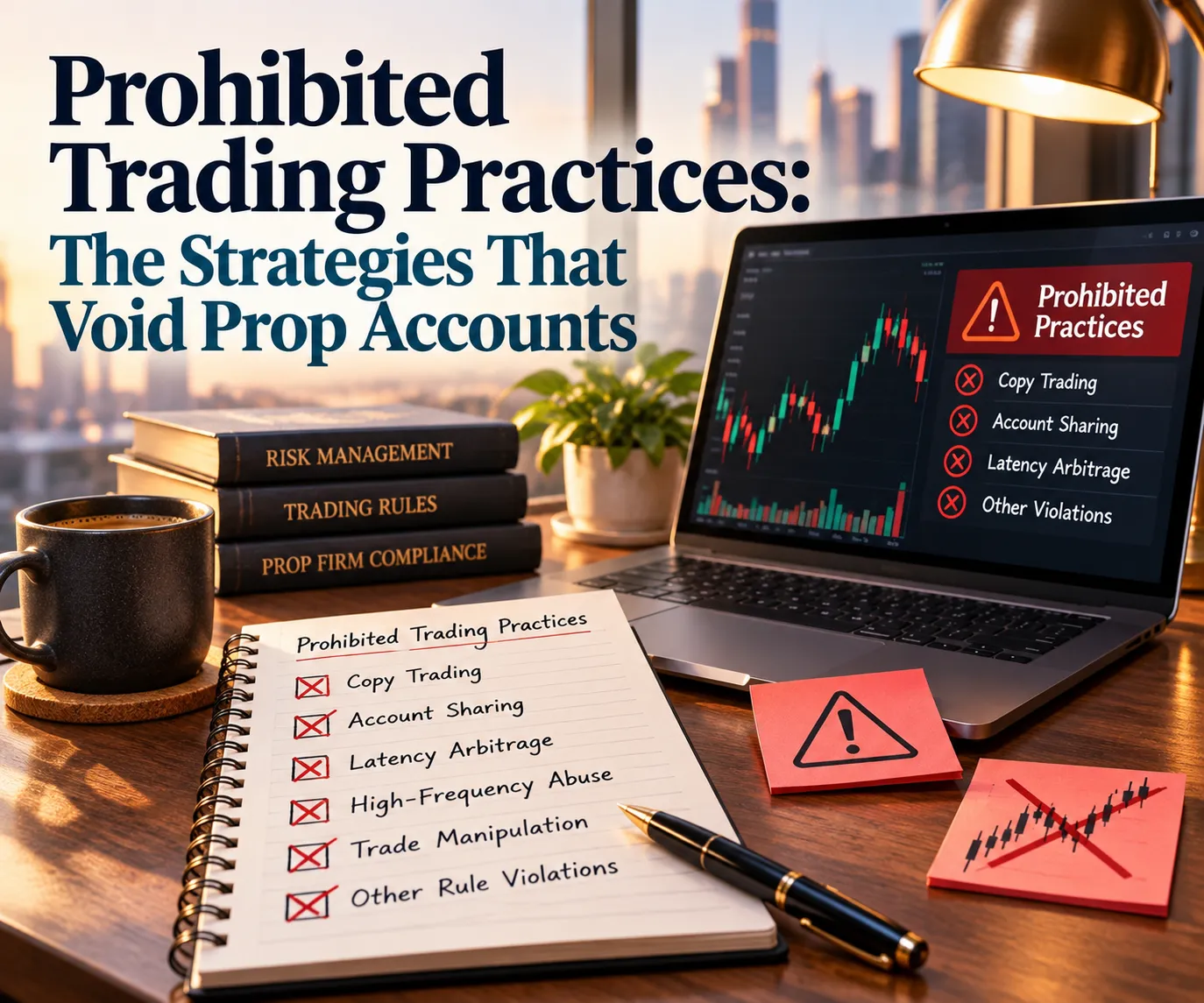
Most accounts that close over a rule breach close because of a number: the daily loss limit, the maximum loss, a floating loss that went too far. A smaller group close for a different reason. The trader hit the target, stayed inside every limit, and then the account was reviewed and the result was removed, because of how the profit was made.
Those are prohibited trading practices. They are written in every firm's terms, they are enforced at review rather than in real time, and they cause the most frustrating disputes in prop trading, because the trader often did not know the rule existed. This guide explains what each practice actually looks like, why firms ban it, what is allowed instead, and exactly where FOREXIVE draws the lines.
Why Prop Firms Ban Certain Strategies
An evaluation is a test of whether a trader can make money under realistic market conditions while managing risk. A prohibited practice is one that produces a result the test was not designed to measure. They fall into three groups:
- Exploiting the environment. Profit that comes from a weakness in the simulated setup, such as a delayed price, rather than from the market. It could not be repeated in a live market, so it says nothing about the trader.
- Removing the risk. Combinations of trades that guarantee one side wins, for example opposite positions on two accounts. The test measures risk management; a trade with no real risk measures nothing.
- Someone else's skill. Another person trading the account, or copying another trader's signals. The firm is evaluating you, not them.
Keep those three groups in mind and most rules make sense on first reading.
The Practices, One by One
| Practice | What it looks like | Why it is banned |
|---|---|---|
| Latency trading | Trading on the gap between a fast external price feed and a slower platform feed, entering before the platform price catches up | Profit comes from a delay in the setup, not from the market |
| Arbitrage (long/short, reverse) | Buying on one venue or account and selling the same instrument on another to capture a price difference | Risk-free by design, and depends on pricing differences that would not exist live |
| High-frequency trading | Software placing very large numbers of orders in fractions of a second | Exploits execution speed and system limits rather than market direction |
| Tick scalping | Large numbers of trades opened and closed within seconds to capture single price ticks | Results depend on fills a live market would not give |
| Cross-account hedging | Long on one account, short the same instrument on another, so one account passes whatever happens | Removes the risk the evaluation is meant to test |
| Reverse trading and group hedging | Two or more traders agree to take opposite sides on their accounts | The same guaranteed-winner logic, coordinated between people |
| Gap trading | Opening a position just before a market closes over a scheduled event, betting on the gap at the reopen | The outcome is decided while the market cannot be traded, so no risk management is possible |
| One-sided betting and all-in trades | One oversized position, or a stack of positions in the same direction, sized to hit the target or fail in a single move | It is a bet, not trading, and it would be catastrophic with real capital |
| Exploiting errors | Trading on a frozen price, a quote that is clearly wrong, or a server delay | Profit from a fault, not from skill |
| Account sharing and pass services | Someone else logs in and trades, or a paid service passes the challenge for you | The firm would be funding a person it never evaluated |
| Copying another trader | Mirroring a signal provider's or a friend's trades onto your account | The result belongs to the other trader |
Three Rules That Catch Ordinary Traders
Few people set out to run latency arbitrage. The prohibited practices that catch ordinary traders are the ones that look like normal trading until you check the numbers.
1. Tick scalping and the one-minute line
Scalping itself is generally allowed. What firms restrict is a pattern of trades closed within seconds. At FOREXIVE the line is specific: no more than 20% of your trades may be closed within one minute of opening, and at the funded stage, profits from such trades are removed.
Take a funded trader with 60 trades in a reward period. Up to 12 of them may close inside a minute. If 18 do, the limit is exceeded, and the profit from those short trades does not count. A scalper who exits quickly on a failed setup can drift over the line without noticing, so count your sub-one-minute trades every week. How profit splits work shows how removed profit changes the reward you actually receive.
2. Hedging on two accounts
Hedging on a single account is a normal risk tool, and FOREXIVE allows it (see below). Hedging across accounts is different. A trader with two $50,000 accounts goes long EURUSD on one and short EURUSD on the other. Whichever way price moves, one account gains and one loses. If the gain hits the target, one account passes, and the trader has bought a pass rather than earned it. That is why cross-account hedging is prohibited even when both accounts belong to you, and why it is also prohibited between different traders acting together.
It can happen without intent. Two strategies running on two accounts can end up on opposite sides of the same pair at the same time. If you run different strategies on different accounts, check for opposite exposure on the same instrument before you enter.
3. A sudden jump in size
FOREXIVE does not set minimum or maximum lot sizes. That freedom has a limit: the terms say trades must follow market-standard risk management, and they name opening substantially larger positions than your other trades as an example of breaking it.
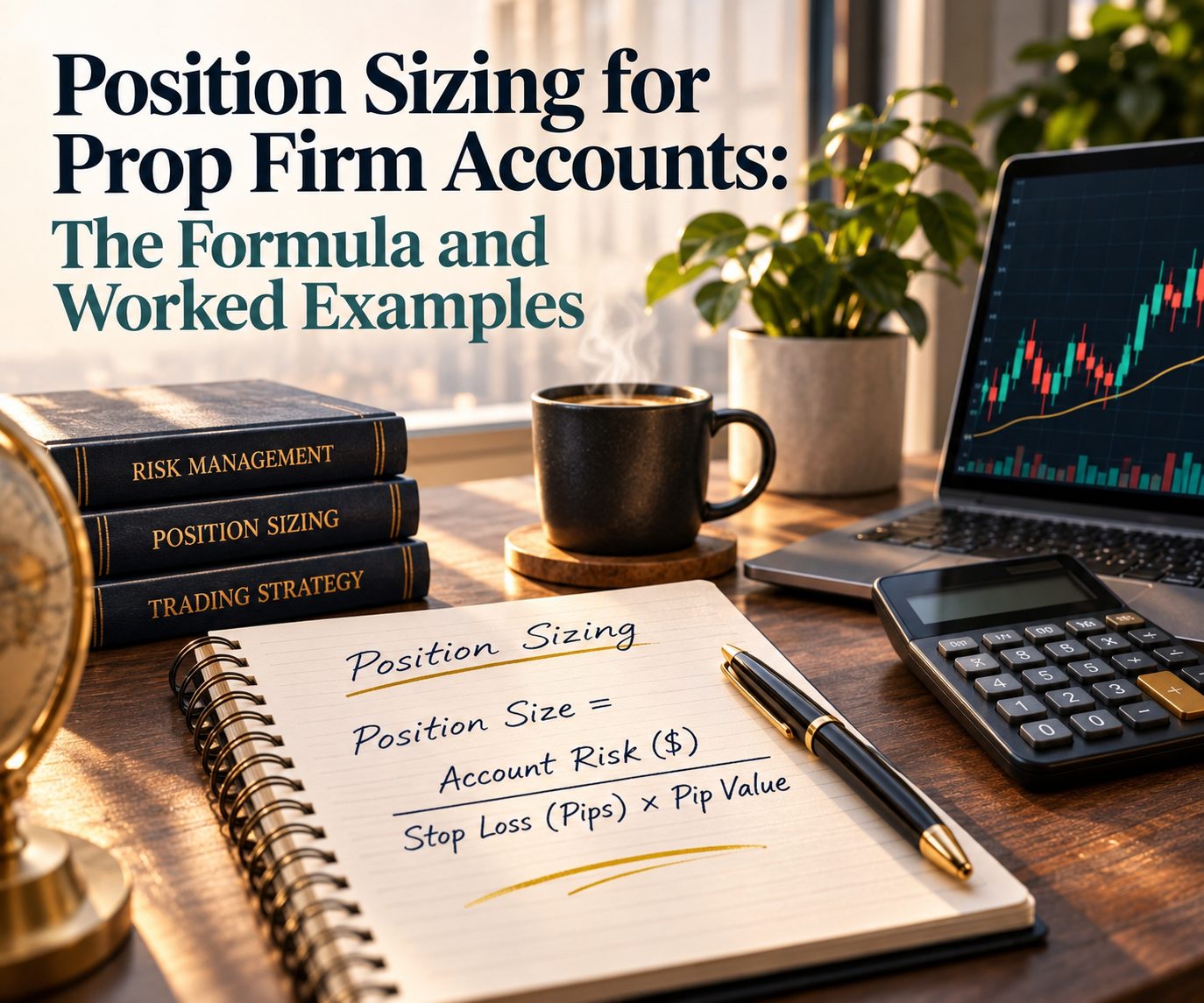
Picture a $100,000 account where the trader has risked 0.5% to 1% per trade for weeks, then opens one position risking 6% to finish the target in a day. No loss limit was touched if it won. But the trade looks like a bet sized to pass, not part of the strategy that produced the rest of the record, and that is exactly what a reviewer looks for. Keep size consistent with your record; the position sizing formula makes that easy.
What Is Allowed, and Often Mistaken for Prohibited
Traders sometimes avoid perfectly legitimate practices because they sound close to a banned one. At FOREXIVE, these are allowed:
- Hedging on the same account. You can open opposing positions on one account, for example to protect an open trade or offset a loss. The exception is Instant, which allows only one open trade at a time, so it cannot be done there.
- Copy trading between your own accounts. Mirroring your trades from one of your FOREXIVE accounts to another is allowed. Copying to or from another person is not.
- News trading in the evaluation. On 1-Step, 2-Step and Access there are no news restrictions in the evaluation phases. On a funded account, profit from a trade closed between 5 minutes before and 5 minutes after a high-impact release (broker time) is deducted and does not count towards rewards. The details are in news trading rules.
- Expert Advisors that manage trades. A third-party EA is allowed if it only manages risk, such as moving stop losses, setting take profits or sizing positions. You activate it by emailing support. An EA that opens trades on its own is not allowed. See EA and copy trading rules for how this works across the industry.
- Any normal trading style. Day trading, swing trading and ordinary scalping are all fine as long as they fit the loss limits. Strategies matched to the rules shows how each style fits.
How FOREXIVE Defines and Enforces It
FOREXIVE runs a zero-tolerance policy on abuse, manipulation and attempts to gain an unfair advantage. The full list sits in the help centre and in section 5.4 of the terms. It covers three areas:
- Prohibited trading practices: high-frequency trading, latency trading, reverse trading, gap trading, any form of arbitrage, tick scalping beyond the 20% one-minute limit, one-sided betting, hyperactive patterns that exploit system limits, limit orders used to guarantee profit in low liquidity, and hedging across accounts or with other traders.
- Account misuse: copying trades to or from another trader, pass-your-challenge services, account management by another person or company, and account sharing. Changing the investor password also counts as a rule violation.
- Platform exploitation: EAs, bots or scripts used to manipulate trading, taking advantage of server errors, price freezes or data delays, and any attempt to get around risk controls.
Gap trading has a precise meaning in the terms: opening a trade when a major news event, economic release or earnings report is scheduled and the market will close for two hours or more within the next two hours. A position opened on Friday afternoon ahead of a weekend event is the typical case.
Accounts are monitored with risk and behaviour analysis. If a prohibited practice is found, the terms allow FOREXIVE to treat the evaluation as failed, remove the offending trades from the record, cancel the services and close the account, or cut leverage to 1:5. Where the practice spans several accounts, every account involved can be closed. On a funded account, once a rule is broken, no reward can be requested on the profits. Copying trades with another trader means all accounts involved are closed with no refund.
How to Avoid Being Flagged by Mistake
Most honest traders never come near these rules. The few who get flagged usually tripped over one of these:
- Trade from one IP address. FOREXIVE advises a single IP, and treats hedging across accounts from the same IP as a violation. If you will be travelling or using another device, tell support in advance.
- Never let anyone else log in. Not a friend, not a mentor, not a "manager". Keep your login details to yourself.
- Check for opposite positions across your accounts before every entry if you run more than one.
- Count your sub-one-minute trades and keep them under 20% of the total.
- Keep position size consistent with your own record, especially near the target.
- Get EA approval in writing before running one, and keep the email.
- Do not trade a price that looks wrong. If a quote freezes or spikes far from the market, stay out and report it.
- Ask before you trade. If you are unsure whether something is allowed, ask support first. An answer before the trade is worth far more than an appeal after it.
Related Reading
Review is also where payout decisions are made: how payouts actually work explains what is checked at each step. If someone messages you offering to pass or manage your account, read how to spot a prop firm scam before you reply. If you plan to use automation, MT5 vs cTrader vs Match-Trader compares what each platform offers. For rule terms you meet in any firm's terms, see the prop firm rules glossary. FOREXIVE's full list of prohibited practices is in the help centre and the terms and conditions, and each model's limits are on the rules page.
Trading involves substantial risk of loss. Evaluation and funded accounts described here are simulated trading environments. Examples in this article are illustrative; the help centre and the terms and conditions are authoritative. Nothing on this page is financial advice, and no outcome is guaranteed.
Frequently asked questions
What strategies are prohibited at prop firms?
Most prop firms prohibit practices that exploit the trading environment (latency trading, arbitrage, high-frequency trading, trading on price errors), remove the risk (hedging across accounts, reverse trading with other traders), or replace your skill with someone else's (account sharing, pass services, copying another trader). Most also restrict tick scalping, gap trading and one-sided all-in bets.
Every firm words its list differently, so read the terms before you trade.
Is hedging allowed at FOREXIVE?
Hedging on the same account is allowed: you can open opposing positions on one account to protect a trade or offset a loss. It is not possible on Instant, which allows one open trade at a time. Hedging across different accounts, whether your own or with other traders, is prohibited.
Is scalping allowed at FOREXIVE?
Yes. What is restricted is tick scalping: no more than 20% of your trades may be closed within one minute of opening. At the funded stage, profits from trades over that limit are removed.
Can I use an Expert Advisor?
Only one that manages trades or risk, for example moving stop losses, setting take profits or sizing positions. Email support to activate it. An EA that opens trades on its own is not allowed, and using one leads to denial of the evaluation or reward and closure of the account.
Can I copy trades between my own accounts?
Yes, copy trading between accounts you own yourself is allowed. Copying trades to or from another trader is prohibited, and all accounts involved are closed with no refund.
Are there lot size limits at FOREXIVE?
There are no minimum or maximum lot sizes. Trades must still follow normal risk management, and the terms name opening positions substantially larger than your other trades as an example of breaking it. Keep your size consistent with your own record.
What happens if I use a prohibited strategy?
Under the terms, FOREXIVE may treat the evaluation as failed, remove the offending trades from your record, close the account, or reduce leverage to 1:5. If the practice involves several accounts, all of them can be closed. On a funded account, once a rule is broken you cannot request a reward on the profits.
Keep reading
All articles
Choose the challenge that fits you
Compare every model and stage, see exactly what you pay and when, and start the challenge that suits how you trade.
FOREXIVE provides demo accounts with fictitious funds for simulated trading only. Rewards depend on performance and the rules of the applicable programme.