

Position Sizing for Prop Firm Accounts: The Formula and Worked Examples
Position size is the one number you control on every trade. Here is the formula, the pip values behind it, and worked examples on forex, gold and indices, checked against real loss limits.
Forexive
· 9 min read
Most traders spend hours choosing where to enter and seconds choosing how much to trade. In a prop firm evaluation that is backwards. The entry decides whether a trade wins. The position size decides whether a losing trade ends your day, your account, or nothing at all.
This guide gives you the formula, the pip values that feed it, and four worked examples on real instruments. Every example is then checked against published loss limits, because a position size is only correct if the rulebook agrees with it.
The Formula
Every position size calculation is the same three steps.
- Decide the risk amount: account size × risk per trade (%).
- Measure the stop distance from your entry to your stop loss, in pips or points.
- Divide the risk amount by what that stop distance costs per lot.
Written as one line:
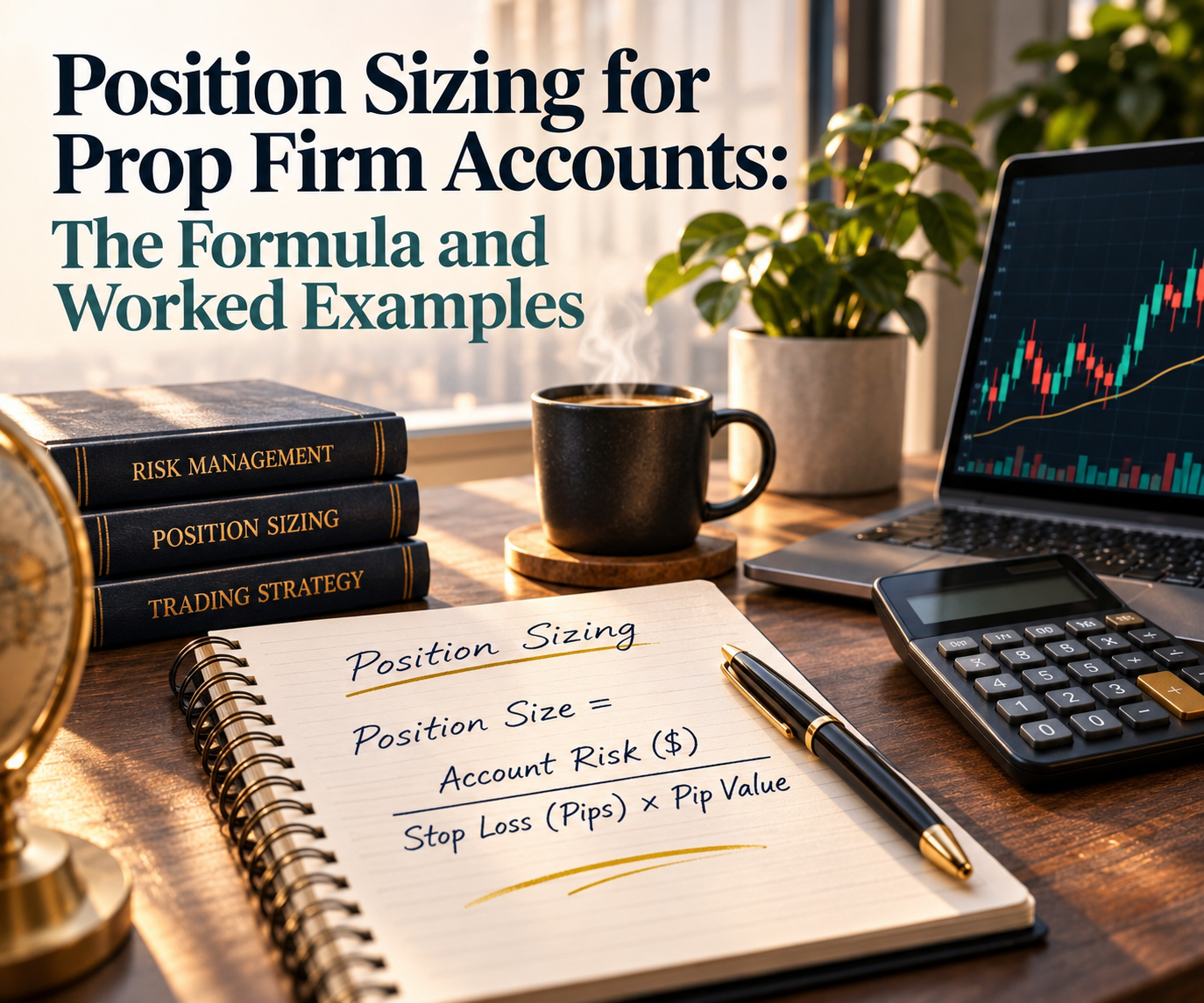
Lots = Risk amount ÷ (Stop distance × Value per pip per lot)
That is the whole calculation. Everything below is about getting the inputs right, because a wrong pip value or a stop measured after the fact will give you a precise answer to the wrong question.
Which balance do you size from?
Size from the figure your loss limits are calculated from. At FOREXIVE, the daily and maximum loss limits are fixed percentages of your initial account balance, so a $100,000 account always has the same dollar allowance, whether it is at $96,000 or $112,000. Sizing from the initial balance keeps your risk in step with the limits that can close the account.
What One Pip Is Worth
The value per pip is where most sizing mistakes start. It depends on the instrument and, for some pairs, on the current exchange rate. For one standard lot (100,000 units of the base currency):
| Instrument | Pip size | Value per pip, 1.00 lot | Notes |
|---|---|---|---|
| EURUSD, GBPUSD, AUDUSD | 0.0001 | $10.00 | Fixed whenever USD is the quote currency |
| USDJPY at 150.00 | 0.01 | $6.67 | $1,000 ÷ the USDJPY rate |
| USDCAD at 1.3700 | 0.0001 | $7.30 | $10 ÷ the USDCAD rate |
| XAUUSD (gold), 100 oz contract | $0.01 | $1.00 per cent, $100 per $1.00 move | Check the contract size on your platform |
| NAS100, $1 per point contract | 1.0 point | $1.00 per point | Index contract sizes vary by platform |
The last two rows carry a warning. Contract specifications for metals and indices differ between platforms and symbols. Before your first trade, open the symbol specification in MetaTrader 5 (MT5) and confirm the contract size. A gold contract of 10 oz instead of 100 oz changes your position size by a factor of ten.
Worked Example 1: EURUSD on a $10,000 1-Step
A $10,000 1-Step account. You risk 0.5% per trade.
- Risk amount: $10,000 × 0.5% = $50
- Stop distance: 20 pips
- Value per pip: $10 per lot
Lots = $50 ÷ (20 × $10) = $50 ÷ $200 = 0.25 lots
Now add the costs. FOREXIVE charges $3 per round lot, so 0.25 lots costs $0.75 in commission. Assuming a 0.2-pip spread (actual spreads vary by pair, session and market conditions), the spread costs another $0.50. If the stop is hit, the real loss is about $51.25, not $50. On one trade it barely matters. Over a 40-trade evaluation it adds up, and a trader who never budgets for costs is consistently risking slightly more than they think.
Costs are not the only gap between planned and actual risk. Slippage can fill a stop worse than its level, especially around news, at the market open or when liquidity is thin. Commission, spread and slippage together mean a real loss can exceed the planned risk, so leave a small buffer instead of sizing right up to your limit.
Worked Example 2: USDJPY on a $100,000 2-Step
A $100,000 2-Step account. Risk is 0.5% per trade, and USDJPY is trading at 150.00.
- Risk amount: $100,000 × 0.5% = $500
- Stop distance: 25 pips
- Value per pip: $1,000 ÷ 150.00 = $6.67 per lot
Lots = $500 ÷ (25 × $6.67) = $500 ÷ $166.67 = 3.00 lots
Notice what happens if you assume $10 per pip, as you would on EURUSD: you get 2.00 lots, a third smaller than necessary. Make the same assumption on a pair quoted in sterling, such as EURGBP, where one pip is worth about $12.70 when GBPUSD trades at 1.27, and you oversize instead. The pip value always comes from the quote currency.
Worked Example 3: Gold on a $50,000 1-Step
A $50,000 1-Step account. Gold is volatile, so you cut risk to 0.4%.
- Risk amount: $50,000 × 0.4% = $200
- Stop distance: $6.00 below entry
- Value: a $1.00 move on a 100 oz contract is $100 per lot, so a $6.00 stop costs $600 per lot
Lots = $200 ÷ $600 = 0.333, rounded down to 0.33 lots
Gold is where oversizing does the most damage, because its stops are wide in dollar terms. A trader who uses the 0.25 lots they would use on EURUSD would be risking $150 per $6 stop, which looks safe, and then $300 on a $12 stop during a news spike. Always size gold from the stop, never from habit.
Worked Example 4: NAS100 on a $25,000 2-Step
A $25,000 2-Step account. Risk is 0.5% per trade on a contract worth $1 per point.
- Risk amount: $25,000 × 0.5% = $125
- Stop distance: 40 points
- Value: $1 per point per lot
Lots = $125 ÷ (40 × $1) = 3.125, rounded down to 3.12 lots
If the same symbol on your platform is specified at $10 per point, the answer is 0.31 lots. That is the same trade at a tenth of the size. Check the specification once, write it down, and you never have to guess again.
Check the Size Against the Rulebook
A position size is only half the job. The other half is asking how many losing trades in a row the account can absorb at that size. Here is the answer for each FOREXIVE model, using the published daily and maximum loss limits.
| Risk per trade | 1-Step (3% daily / 6% max) | 2-Step (5% daily / 12% max) | Access evaluation (5% daily / 10% max) | Instant (2% daily / 3% max) |
|---|---|---|---|---|
| 0.25% | 12 losses / 24 losses | 20 / 48 | 20 / 40 | 8 / 12 |
| 0.50% | 6 / 12 | 10 / 24 | 10 / 20 | 4 / 6 |
| 1.00% | 3 / 6 | 5 / 12 | 5 / 10 | 2 / 3 |
| 2.00% | 1.5 / 3 | 2.5 / 6 | 2.5 / 5 | Not permitted |
Once an Access account is funded, its limits drop to 3% daily and 6% maximum, the same as the 1-Step column.
Read the 1-Step column at 1% risk. Three losses end the day and six end the account. A strategy with a 45% win rate will see six losses in a row more often than most traders expect: over 100 trades, the chance of at least one losing streak of six is roughly 73%, assuming each trade is independent and the win rate holds steady at 45%. At 0.5% risk the same streak costs 3%. That reaches the daily limit only if every loss lands on the same day, and it leaves half of the maximum loss untouched.
Two rules that cap your size directly
- Floating risk limit. On 1-Step, 2-Step and Access, open positions must never show an unrealised loss of 3% or more of the balance or equity. This applies to all open trades together. Three positions each risking 1% can breach it before any stop is hit, especially if the trades are correlated.
- Instant maximum loss per trade. On Instant, no single trade may risk or lose more than 1% of the initial balance, and only one trade can be open at a time. On a $10,000 Instant account, that caps every stop at $100.
Size to the Room You Have Left Today
The table above assumes a fresh day. Halfway through a losing day the question changes. If your $10,000 1-Step account has a $300 daily allowance and you are already down $200, your remaining room is $100. A trade that risks $50 is fine. Two of them open at once are not.
Before each trade after a loss, compare the planned risk with the room left between your equity and the daily floor. If the trade does not fit, it is not a smaller trade you need. It is tomorrow. Our guide to daily loss limits and the balance versus equity question explains exactly how that floor is calculated.
Five Sizing Mistakes That End Accounts
- Choosing the size first and the stop second. The stop belongs where the trade idea is proven wrong. Size follows from it, never the other way round.
- Widening the stop without cutting the size. Moving a stop from 20 to 40 pips at the same lot size doubles the risk on that trade.
- Using the wrong pip value. Assuming $10 per pip on every pair undersizes some trades and oversizes others.
- Rounding up. Always round lots down. The difference is small per trade and decisive across a losing streak.
- Ignoring combined exposure. EURUSD and GBPUSD long at 0.5% each is close to a single 1% bet on the dollar. Count correlated positions as one.
A Pre-Trade Checklist
- Is the stop placed where the setup is invalidated?
- Is the risk amount calculated from the initial balance?
- Is the pip value correct for this symbol and its contract size?
- Is the lot size rounded down?
- Does total open risk comply with the floating risk restriction applicable to your account model (3% on 1-Step, 2-Step and Access; on Instant, a 1% limit per trade with one trade open at a time)?
- Does the trade fit inside today's remaining daily room?
Six questions, about thirty seconds. That is the cheapest risk management you will ever do.
Related Reading
Position size turns a plan into a number. Our guide to planning the numbers before you trade shows how to choose the risk percentage in the first place, and static versus trailing drawdown explains why the type of loss limit matters as much as its size. If you are still choosing a model, compare 1-Step, 2-Step and Instant, or see how sizing interacts with each style in the best strategies for prop firm challenges.
FAQs
What is the position sizing formula for a prop firm account?
Lots = risk amount ÷ (stop distance × value per pip per lot). The risk amount is your account size multiplied by your chosen risk per trade.
How much should I risk per trade on a prop firm challenge?
Work it out from the loss limits and your own worst losing streak. On a model with a 3% daily limit, 0.25% to 0.5% per trade leaves room for a normal run of losses. Risking 1% leaves room for three.
Should I size from my current balance or my starting balance?
Size from whatever your loss limits are calculated from. At FOREXIVE the limits are fixed percentages of the initial balance, so the initial balance is the right base.
Does a bigger account change how I size positions?
No. The percentages are identical at every size. A $100,000 account at 0.5% risk and a $10,000 account at 0.5% risk carry the same risk of breach. Only the lot sizes and the fee change.
Are there lot size limits at FOREXIVE?
There are no minimum or maximum lot sizes. The limits that matter are the daily and maximum loss limits, the 3% floating risk limit on 1-Step, 2-Step and Access, and the 1% maximum loss per trade on Instant.
How do I size gold or index trades?
Use the same formula, but take the value per point from the symbol's contract specification on your platform. Contract sizes for metals and indices vary, and getting them wrong changes your size by a factor of ten.
Trading involves substantial risk of loss. Evaluation and funded accounts described here are simulated trading environments. Figures in this article are illustrative, and contract specifications should be confirmed on your trading platform. Nothing on this page is financial advice, and no outcome is guaranteed.
Keep reading
All articles
Choose the challenge that fits you
Compare every model and stage, see exactly what you pay and when, and start the challenge that suits how you trade.
FOREXIVE provides demo accounts with fictitious funds for simulated trading only. Rewards depend on performance and the rules of the applicable programme.